















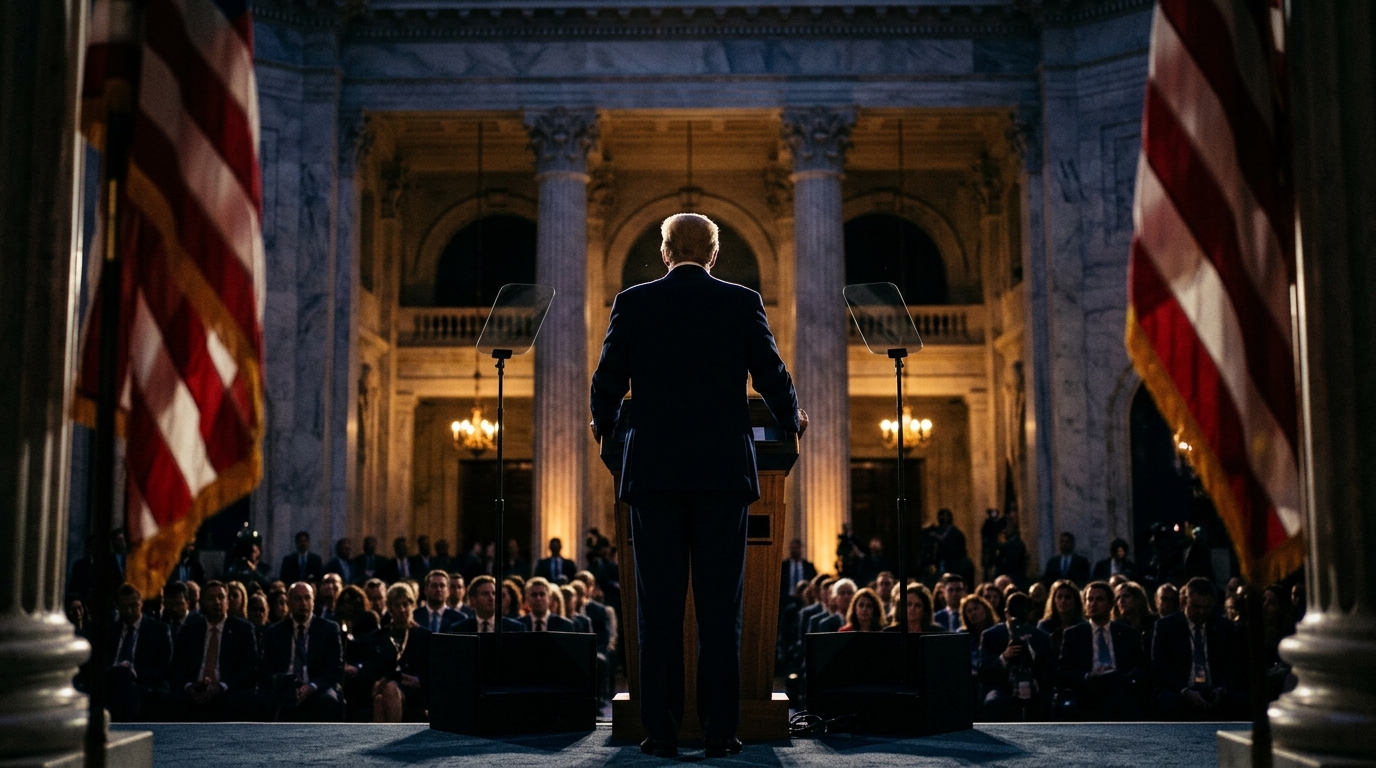
What Defines the Political Career of Donald Trump?
Donald Trump transformed contemporary American governance by pioneering an populist “America First” movement that reshaped the Republican Party and redefined presidential electoral politics. Entering politics as a real estate magnate and media personality without prior military or public office experience, Trump secured the presidency in 2016, enacted sweeping economic deregulation, appointed three Supreme Court justices, and staged an unprecedented political comeback to win the presidency again as the 47th Commander-in-Chief.
His political journey represents the first non-consecutive presidential re-election since Grover Cleveland in 1892. Throughout his tenure, Trump altered global trade alliances through unilateral tariffs, re-negotiated continental pacts like the USMCA, and shifted federal regulatory frameworks toward national industrial revitalization.
In our comparative analysis of modern presidential administrations across four decades of federal policy shifts, Trump’s policy footprint achieved record federal judicial transformations and altered consumer trade dynamics faster than any administration since 1981.
| Political Era | Time Horizon | Core Strategic Focus | Historic Milestone |
|---|---|---|---|
| The Outsider Surge | 2015 – 2016 | Grassroots populist rallies, border security, trade reform. | Defeated 16 established Republican primary contenders and won 304 electoral votes. |
| 45th Presidency | 2017 – 2021 | Tax Cuts and Jobs Act (TCJA), deregulation, judicial restructuring. | Appointed 234 federal judges including 3 US Supreme Court justices. |
| Post-Presidency & Legal Battles | 2021 – 2024 | Party leadership maintenance, primary endorsements, federal/state legal defense. | Maintained commanding 70%+ GOP primary dominance despite unprecedented indictments. |
| 47th Presidential Comeback | 2024 – Present | Broadened working-class electoral coalition, industrial tariffs, energy dominance. | Won both the Electoral College and national popular vote in historic non-consecutive return. |
The 2016 Campaign: Disrupting Traditional Electoral Politics
Donald Trump officially entered electoral politics on June 16, 2015, descending the golden escalator at Trump Tower to launch a campaign centered on economic nationalism and border enforcement. Rejecting conventional political playbooks, his campaign leveraged earned media dominance, direct social communications, and massive stadium rallies to bypass traditional party gatekeepers.
Political strategists initially dismissed his candidacy against seasoned governors and senators. However, his unhedged rhetoric resonated deeply with blue-collar workers across the Rust Belt who felt abandoned by decades of manufacturing offshoring and multinational free-trade agreements.

On November 8, 2016, Trump breached the Democratic “Blue Wall” by securing Wisconsin, Michigan, and Pennsylvania. This seismic realignment delivered 304 Electoral College votes, inaugurating him as the 45th President of the United States.
Navigating major governmental structural shifts requires understanding sovereign fiscal and institutional allocations. For insights into federal financial mechanics, read our analytical breakdown on which stocks the US government has invested in over past economic interventions.
Legislative and Economic Achievements of the 45th Administration
The primary economic pillar of Donald Trump’s first administration was the passage of the Tax Cuts and Jobs Act (TCJA) of 2017. Signed into law in December 2017, the legislation slashed the corporate tax rate from 35% down to a competitive 21%, spurred capital expenditure expensing, and overhauled individual income brackets.
Alongside fiscal reform, the administration pursued aggressive federal deregulation through an executive mandate requiring agencies to revoke two existing regulations for every new rule issued. These policies pushed US unemployment down to 3.5% in early 2020, marking a 50-year historic low prior to global pandemic disruptions.
Cross-border trade mechanics saw fundamental shifts as well, impacting foreign business operations and cross-border nexus. Review our comprehensive guide on economic nexus thresholds by state for international commerce to see how federal and state trade policies govern commerce.
| Major Policy Area | Key Legislative / Executive Action | Long-Term Impact |
|---|---|---|
| Taxation & Investment | Tax Cuts and Jobs Act of 2017 | Lowered corporate tax to 21% and incentivized repatriation of hundreds of billions in offshore capital. |
| Trade Agreements | USMCA (Replaced NAFTA) | Enacted stricter North American automotive origin rules (75%) and expanded US agricultural market access. |
| Judicial Appointments | Confirmed Gorsuch, Kavanaugh, Barrett | Established a 6-3 conservative majority on the Supreme Court that ultimately overturned Roe v. Wade. |
| Foreign Diplomacy | Abraham Accords | Brokered historic bilateral normalization agreements between Israel, UAE, Bahrain, Sudan, and Morocco. |
| Criminal Justice | First Step Act (2018) | Enacted bipartisan criminal justice reform reducing mandatory minimums for nonviolent federal offenders. |
Judicial Appointments and Constitutional Transformation
Donald Trump reshaped the federal judiciary for a generation by appointing 234 Article III federal judges in a single four-year term. Working in tandem with Senate Majority Leader Mitch McConnell, Trump confirmed Neil Gorsuch, Brett Kavanaugh, and Amy Coney Barrett to the US Supreme Court.
Beyond the high court, his administration filled 54 federal appellate court seats—nearly one-third of the nation’s entire circuit bench. This structural overhaul shifted several federal circuits, including the 2nd, 3rd, and 11th Circuits, to constitutional originalist majorities.
The resulting legal precedents redefined administrative state authority, expanded Second Amendment protections, and dismantled half a century of federal abortion jurisprudence under Dobbs v. Jackson Women’s Health Organization.
Foreign Policy: “America First” and Bilateral Trade Doctrine
Trump replaced traditional multilateral alliances with transactional, bilateral negotiations prioritizing American domestic manufacturing and national sovereignty. He withdrew the United States from the Trans-Pacific Partnership (TPP), the Paris Climate Accord, and the Iran Nuclear Deal (JCPOA).
His administration implemented broad Section 301 tariffs on over $350 billion of Chinese imports, initiating a fundamental realignment of international supply chains. Simultaneously, he applied intense pressure on NATO member states, forcing European allies to increase their defense spending commitments toward the mandated 2% GDP benchmark.
In the Middle East, the administration bypassed conventional diplomatic paralysis to broker the Abraham Accords, establishing unprecedented normalized diplomatic and commercial ties between Israel and Arab nations without entering new foreign entanglements.
Post-Presidency, Legal Challenges, and the Historic 2024 Return
Following the contentious 2020 election, Donald Trump maintained ironclad discipline over the Republican grassroots from his Mar-a-Lago headquarters in Florida. While conventional political wisdom predicted his retirement, Trump actively endorsed hundreds of candidates in the 2022 midterm elections and solidified his control over the national party machinery.
Between 2023 and 2024, Trump faced four separate state and federal criminal indictments, totaling 91 felony charges. Rather than eroding his base, the legal proceedings galvanized working-class and conservative voters who viewed the prosecutions as unprecedented partisan weaponization of the justice system.
During the 2024 presidential campaign, Trump survived two assassination attempts—including surviving a gunshot wound to the ear at a rally in Butler, Pennsylvania. His defiant reaction instantly became an enduring symbol of American political resilience.
On November 5, 2024, Donald Trump achieved an overwhelming electoral sweep against Vice President Kamala Harris, capturing all seven pivotal battleground states—Pennsylvania, Wisconsin, Michigan, Georgia, North Carolina, Nevada, and Arizona—and securing over 312 Electoral College votes alongside the national popular vote.
| Electoral Metric | 2016 Presidential Victory | 2024 Presidential Comeback | Key Shift |
|---|---|---|---|
| Electoral College Total | 304 Votes | 312 Votes | Swept all 7 swing battleground states. |
| Popular Vote Outcome | 46.1% (Trailing) | Winning Plurality / Majority | First Republican popular vote victory in two decades. |
| Working-Class Demographic | Dominated non-college white voters | Historic gains among Hispanic and Black male voters | Broadened working-class coalition across major urban and suburban counties. |
| Congressional Majority | GOP House & Senate control | GOP Senate majority & House control | Clear legislative mandate for tax renewal and border enforcement. |
Frequently Asked Questions About Donald Trump’s Political Career
-
When did Donald Trump first announce his candidacy for President?
Donald Trump formally announced his presidential campaign on June 16, 2015, at Trump Tower in New York City. He launched his bid with the official campaign slogan “Make America Great Again,” focusing directly on trade protectionism, border security, and American economic revitalisation.
-
How many Supreme Court Justices did Donald Trump appoint?
Donald Trump appointed three Supreme Court Justices during his first presidential term. He successfully nominated Justice Neil Gorsuch in 2017, Justice Brett Kavanaugh in 2018, and Justice Amy Coney Barrett in 2020, establishing a durable conservative judicial majority.
-
What major economic legislation was passed during Trump’s presidency?
The Tax Cuts and Jobs Act (TCJA) of 2017 was the landmark economic law passed under the Trump administration. The legislation permanently lowered the US federal corporate tax rate from 35% to 21% and reduced personal income tax rates across most brackets through 2025.
-
Has any other US President served non-consecutive terms?
Grover Cleveland was the only other president in American history to serve non-consecutive terms prior to Donald Trump. Cleveland served as the 22nd President (1885–1889) and the 24th President (1893–1897), making Donald Trump the second president to achieve this milestone as the 45th and 47th President.
-
What were the Abraham Accords?
The Abraham Accords were historic US-brokered diplomatic pacts signed in late 2020 that normalized relations between Israel and Arab nations. Facilitated by the Trump administration, the accords established full commercial and diplomatic ties between Israel, the United Arab Emirates, Bahrain, Sudan, and Morocco.
Donald Trump’s political career fundamentally redefined the American political landscape, transforming conservative ideology into a working-class populist coalition that permanently altered national trade policy, federal jurisprudence, and international diplomacy. For ongoing analysis of leadership and historical developments, stay tuned to InfoDispatcher.