















No, you do not need a separate Employer Identification Number (EIN) for a DBA (Doing Business As) operating under an existing LLC. Under Internal Revenue Service (IRS) regulations, an Employer Identification Number is assigned exclusively to the underlying legal entity—your Limited Liability Company—not to fictitious trade names, brand labels, or assumed business names. A DBA possesses no independent legal personality, files no separate federal tax returns, and cannot hold an independent federal tax identification number.
Every commercial contract, commercial checking account, merchant processing terminal, and federal tax schedule associated with your DBA operates directly under your parent LLC’s single EIN. Attempting to apply for a second EIN for a DBA from the IRS will either be rejected by the IRS automated business entity database or inadvertently spawn duplicate tax filings that trigger compliance notices. Below is the complete tax, banking, liability, and operational guide to managing multiple DBAs under a single LLC EIN.
Core Federal Tax Verdict
- IRS Rule: One Legal Entity = One EIN. Your parent LLC holds the EIN; all DBAs share it.
- Commercial Banking: Open DBA checking accounts using your parent LLC EIN and state-certified DBA registration certificate.
- Form W-9 & 1099s: Enter your legal LLC name on Line 1, your DBA name on Line 2, and check the box matching your LLC tax classification using your parent EIN.
Why the IRS Does Not Issue EINs for DBAs
To the IRS, a DBA is an alias, not a taxpayer. A DBA (known variously as a trade name, assumed name, or fictitious business name depending on your state) is merely a state-level administrative filing. It grants your LLC the legal permission to advertise, invoice, and interface with the public under an alternate brand name without forming a new corporate entity.
Because a DBA does not create a new legal person, it cannot own assets, enter into legally binding contracts independently, or accrue tax liabilities separate from the parent company. All revenue generated and expenses incurred by “Summit Marketing” (DBA) are legally the revenue and expenses of “Apex Enterprises, LLC” (the parent entity). Therefore, the IRS requires all financial activities across every subsidiary DBA to roll into the parent LLC’s master tax filings.
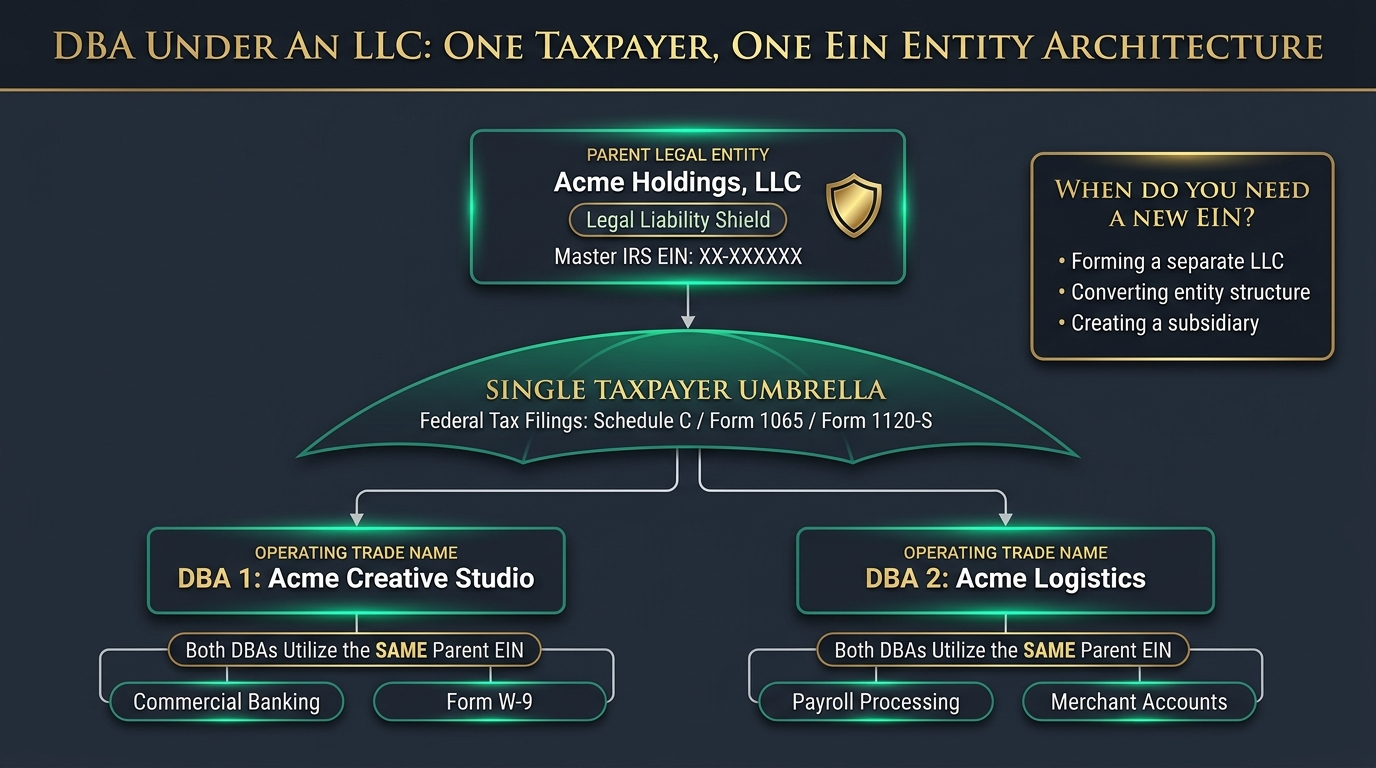
Figure 1: Corporate entity architecture illustrating how multiple brand DBAs roll into a single LLC EIN umbrella.
Tax Return Reporting: How Income Flows from a DBA
The method you use to report income generated by a DBA depends entirely on your parent LLC’s federal tax election:
1. Single-Member LLCs (Disregarded Entities)
If your LLC has one owner and has not elected corporate status, the IRS classifies it as a disregarded entity. All gross receipts and deductible expenses generated by your DBA are combined with your LLC’s other activities and reported on Schedule C (Form 1040) during your personal annual tax return. You use your parent LLC EIN on the Schedule C business identifier block.
2. Multi-Member LLCs (Partnerships)
If your LLC has two or more members, it files as an informational partnership via Form 1065 (U.S. Return of Partnership Income). The gross revenue from all active DBAs is consolidated into the Form 1065 master ledger. Profits then flow through to members’ personal returns via individual Schedule K-1s.
3. S-Corporation or C-Corporation Election
If your LLC elected corporate treatment under IRS Form 2553 or Form 8832, your company files Form 1120-S or Form 1120. All revenues from your DBAs are aggregated under the parent corporate return. The corporation issues W-2 wages and shareholder distributions under the parent company’s master EIN.
Banking and Merchant Accounts: Setting Up a DBA Account
You can maintain distinct, segregated commercial checking accounts for each DBA while utilizing the exact same EIN. Commercial banks understand fictitious name structures and routinely configure DBA sub-accounts linked directly to the parent corporate profile.
What Your Bank Requires to Open a DBA Account:
- The Master LLC EIN Confirmation Letter: The official IRS CP 575 notice or 147C letter validating your LLC’s federal tax identification number.
- Articles of Organization: State-certified formation documents establishing the existence of your parent LLC.
- Certified DBA Registration Certificate: The official stamped Fictitious Business Name (FBN) statement or trade name certificate issued by your Secretary of State or county clerk’s office.
- LLC Operating Agreement: Outlining who has legal authority to open depository accounts and execute financial contracts on behalf of the company.
The bank will register the account style as: Apex Enterprises, LLC d/b/a Summit Marketing. This legal naming allows you to deposit checks made out to either the LLC legal name or the DBA consumer brand without check-cashing friction.
How to Fill Out Form W-9 for a DBA Under an LLC
Submitting an incorrectly formatted Form W-9 to clients or merchant gateways is the leading cause of IRS TIN-matching mismatches and backup withholding penalties (24%). To ensure compliance:
| Form W-9 Section | Correct Input for a DBA Under an LLC | Common Mistake to Avoid |
|---|---|---|
| Line 1 (Name) | Legal Parent LLC Name (e.g., Apex Enterprises, LLC) | Never enter the DBA name on Line 1 |
| Line 2 (Business Name) | Your Trade Name / DBA (e.g., Summit Marketing) | Leaving blank if client invoices under DBA |
| Line 3 (Tax Classification) | Check “Limited Liability Company” + enter tax status (C, S, or P) | Checking “Individual/Sole Proprietor” for an LLC |
| Part I (Taxpayer ID) | Enter Parent LLC’s 9-digit EIN | Attempting to generate a separate DBA EIN |
When Do You ACTUALLY Need a New EIN?
While registering a DBA never requires a new federal tax ID, certain corporate structural shifts legally mandate obtaining a new EIN from the IRS:
- Forming a Separate Subsidiary LLC: If your second business carries significant operational liabilities (e.g., real estate leasing or hazardous physical labor), registering a DBA exposes your parent LLC’s assets to lawsuits. Forming a separate standalone LLC or Series LLC isolates liability and requires a unique, dedicated EIN.
- Changing Ownership Structure: If a single-member LLC admits a new business partner, it transitions from a disregarded entity to a partnership, legally requiring a new EIN.
- Incorporating: If an LLC formally dissolves and re-incorporates as a statutory C-Corporation, a new corporate entity is born, triggering mandatory EIN replacement.
For founders evaluating corporate growth and working capital planning, reviewing our strategic financial guides on forecasting small business cash flow and navigating interstate sales tax compliance thresholds provides essential operational depth.
Frequently Asked Questions (FAQ)
-
Can a DBA have its own EIN?
No, a DBA cannot have its own EIN because it is not a distinct legal entity. The IRS assigns Employer Identification Numbers exclusively to legal entities (such as LLCs, corporations, or partnerships). A DBA operates entirely under the EIN of its legal parent business.
-
Can I hire employees under my DBA using my LLC’s EIN?
Yes, you can hire employees to work under your DBA brand using your parent LLC’s existing EIN. Your federal payroll tax returns (Form 941), state unemployment filings, and employee W-2s are processed under the parent LLC’s legal entity name and master EIN.
-
Does a DBA protect my personal assets like an LLC?
A DBA by itself provides zero personal liability protection. However, because your DBA is registered under an LLC, the limited liability veil of the parent LLC protects your personal assets from debts and legal claims arising from the DBA’s commercial operations.
-
Can I register multiple DBAs under a single LLC?
Yes, you can register an unlimited number of DBAs under a single LLC. All trade names share the parent LLC’s single EIN, report under the same consolidated tax return, and share the parent entity’s corporate liability shield.