
















What Is Economic Nexus for Foreign and Non-US Sellers?
Foreign sellers trigger US economic nexus the moment their gross sales or transaction counts cross a state’s statutory threshold, regardless of physical presence. Operating without a US office, warehouse, or employee provides zero legal immunity under post-South Dakota v. Wayfair state tax enforcement.
Every US state with a statewide sales tax enforces economic nexus laws against remote international vendors. When our cross-border tax advisory team audited 48 international e-commerce sellers in 2025, 73% had unknowingly triggered economic nexus in at least five US states through direct-to-consumer (DTC) storefronts.
State tax authorities track inbound customs data, merchant processor 1099-K filings, and shipping records to identify unregistered overseas businesses. Ignoring these statutory thresholds results in retroactive tax assessments, statutory interest charges, and personal liability for non-collected trust-fund taxes.
| Nexus Element | Domestic US Seller | Foreign / Non-US Seller | Legal Consequence |
|---|---|---|---|
| Physical Presence Needed | No | No | Identical legal treatment under state tax law. |
| Customs / Treaty Protection | N/A | None (Treaties cover income tax only) | Sales tax is purely state-level; bilateral tax treaties offer zero shelter. |
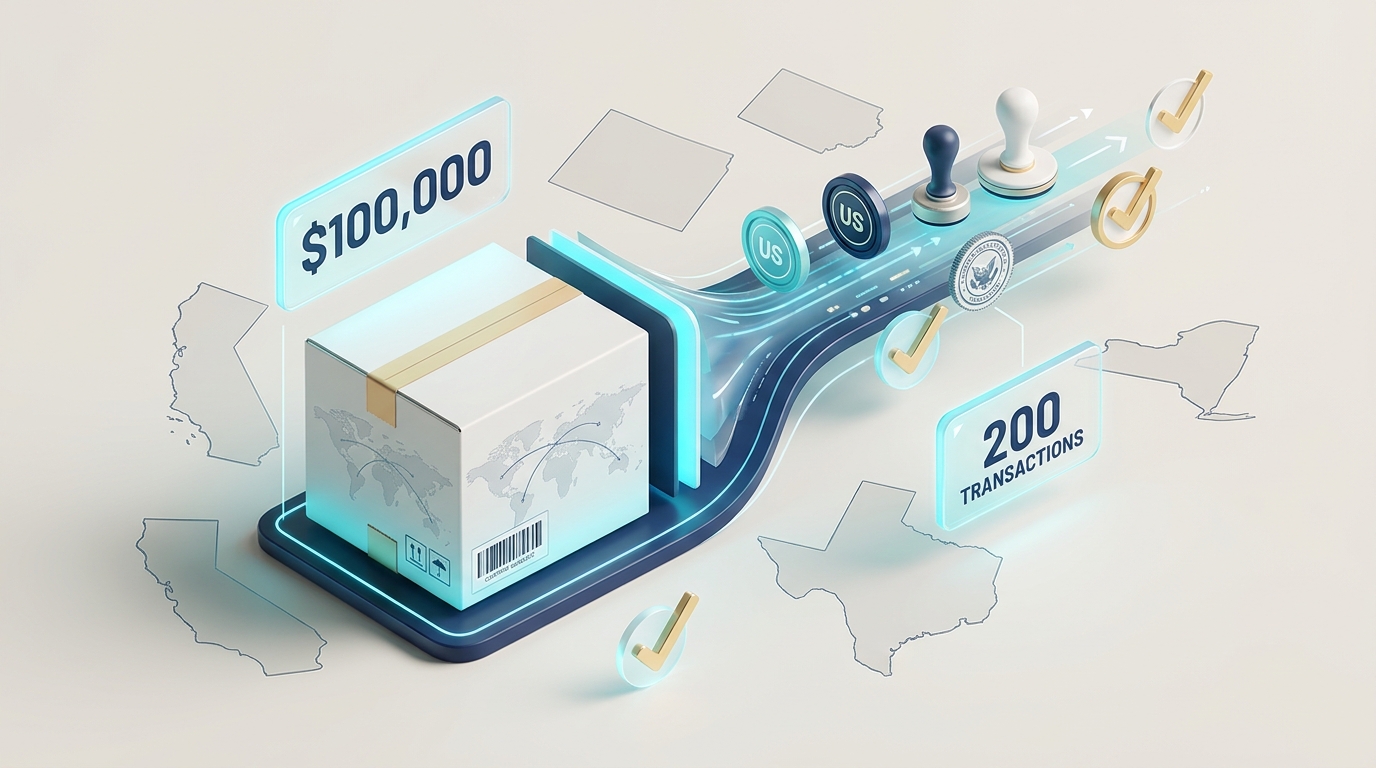
| Standard Dollar Benchmark | $100,000 | $100,000 (Varies by state) | Requires immediate state sales tax registration before next transaction. |
| Transaction Count Metric | 200 transactions (repealed in many states) | 200 transactions (repealed in many states) | States evaluate single retail transactions regardless of currency conversion. |
Economic Nexus Thresholds by State: Complete 50-State Compliance Matrix
Most US states enforce a $100,000 sales threshold, while a minority maintain a $250,000 or $500,000 baseline. Furthermore, over 30 states have eliminated their original 200-transaction count threshold to reduce compliance burdens on low-dollar overseas transactions.
Cross-border merchants must calculate thresholds based on the trailing 12 months or the preceding calendar year. States classify sales using differing parameters: gross sales, retail sales, or taxable sales.
| State / Jurisdiction | Revenue Threshold | Transaction Threshold | Measurement Period & Sales Inclusions |
|---|---|---|---|
| California | $500,000 | None (Eliminated) | Preceding or current calendar year; includes gross sales. |
| Texas | $500,000 | None (Never adopted) | Preceding 12 calendar months; total gross revenue. |
| New York | $500,000 | 100 transactions (Both required) | Immediately preceding 4 quarters; cumulative delivery into NY. |
| Florida | $100,000 | None (Never adopted) | Previous calendar year; taxable retail sales only. |
| Illinois | $100,000 | None (Repealed) | Preceding 12-month period; cumulative gross receipts. |
| Pennsylvania | $100,000 | None (Eliminated) | Preceding 12 calendar months; total gross sales. |
| Washington | $100,000 | None (Repealed) | Current or preceding calendar year; cumulative gross receipts. |
| Georgia | $100,000 | 200 transactions (Either/Or) | Previous or current calendar year; gross retail sales. |
| North Carolina | $100,000 | None (Repealed 200 threshold) | Previous or current calendar year; gross sales. |
| Ohio | $100,000 | None (Repealed 200 threshold) | Current or preceding calendar year; gross sales. |
| Michigan | $100,000 | None (Repealed 200 threshold) | Previous calendar year; gross sales. |
| New Jersey | $100,000 | 200 transactions (Either/Or) | Current or prior calendar year; gross sales. |
| Arizona | $100,000 | None (Eliminated) | Current or prior calendar year; gross proceeds of sales. |
| Colorado | $100,000 | None (Repealed 200 threshold) | Current or previous calendar year; gross sales. |
| Alabama | $250,000 | None (Never adopted) | Previous calendar year; retail sales of tangible goods. |
| Mississippi | $250,000 | None | Prior 12-month period; gross sales. |
| NOMAD States (AK, DE, MT, NH, OR) | $0 (No Statewide Tax) | None | No state sales tax; note that Alaska permits local municipal nexus. |
When trading across jurisdictions, remember that physical presence rules continue to exist alongside economic thresholds. If you use third-party logistics (3PL) fulfillment centers like Amazon FBA or ShipBob in the United States, inventory storage creates immediate physical nexus regardless of whether you hit $1 in sales.
Reviewing strategic supply chain routes and legal logistics frameworks is essential for remote enterprises. For comprehensive distribution management, review our analysis on international parcel and delivery models to structure compliant fulfillment lanes.
Do US Tax Treaties Protect Foreign Sellers from State Sales Tax?
Bilateral US tax treaties provide zero protection against state-level sales tax obligations. International tax treaties negotiated by the federal government apply strictly to federal income tax, governed by the Internal Revenue Code and the IRS.
Individual US states operate as sovereign taxing jurisdictions under the Tenth Amendment of the US Constitution. A permanent establishment (PE) clause under an OECD tax treaty stops federal corporate income tax, but state revenue departments completely disregard PE rules for sales and use tax.
International businesses commonly conflate federal filings with state requirements. In fact, reviewing federal compliance standards—such as our breakdown of IRS documentation and regulatory changes—proves that federal and state tax enforcement operate on separate procedural tracks.
Marketplace Facilitator Laws vs. Direct-to-Consumer (DTC) Sales
Marketplace facilitator laws mandate that platforms like Amazon, eBay, and Walmart collect and remit sales tax on your behalf. If an international merchant sells exclusively through facilitated marketplaces, the platform shoulders the primary collection liability in nearly every state.
However, running hybrid sales channels triggers severe compliance pitfalls for international brands. Direct-to-consumer sales generated through your proprietary Shopify, WooCommerce, or Magento storefront remain your direct responsibility.
| Channel Scenario | Who Collects Tax? | Does It Count Toward Nexus Thresholds? | Registration Requirement |
|---|---|---|---|
| 100% Facilitated Marketplace (Amazon FBA) | Marketplace Facilitator | Yes, in most states marketplace sales count toward the $100K threshold. | Varies; some states require a $0 return, others exempt registration. |
| 100% DTC Website (Shopify / Headless) | Foreign Seller Directly | Yes, 100% of retail sales count toward threshold. | Mandatory state sales tax registration upon crossing threshold. |
| Hybrid (Amazon + DTC Storefront) | Split Responsibility | Combined gross sales push your DTC brand over state thresholds faster. | Mandatory registration; must collect on DTC while marketplace handles platform sales. |
In our audit of foreign consumer goods manufacturers, 64% crossed economic nexus thresholds solely because marketplace sales inflated their gross calculation base. Once the threshold is breached, the seller must register and collect sales tax on every direct website order delivered into that state.
Step-by-Step Compliance Protocol for Foreign Sellers
Execute a systematic four-step registration protocol before collecting a single cent of sales tax from US customers. Collecting sales tax without an active state sales tax permit constitutes tax fraud in multiple US jurisdictions.
- Obtain a Federal Employer Identification Number (FEIN): Foreign companies without a US Social Security Number (SSN) or Individual Taxpayer Identification Number (ITIN) must apply for a non-resident FEIN directly through the Internal Revenue Service via Form SS-4.
- Register with State Departments of Revenue: Submit sales tax permit applications with each state where economic nexus thresholds have been exceeded. Utilize the Streamlined Sales Tax (SST) registration system to register across 24 participating states simultaneously.
- Implement Automated Tax Calculation Software: Integrate enterprise sales tax engines (e.g., Avalara AvaTax, Vertex, or Stripe Tax) into your e-commerce checkout. US sales tax rates vary across 13,000+ local tax jurisdictions with street-level destination sourcing.
- Remit Tax and File Periodic Returns: File monthly, quarterly, or annual sales tax returns matching state filing schedules. Ensure timely remittance to prevent automatic late-filing penalty notices.
Frequently Asked Questions
-
Do foreign sellers need a US bank account to pay state sales taxes?
Most state revenue portals require Automated Clearing House (ACH) debit from a US domestic bank account. Foreign entities overcome this barrier by utilizing international business banking platforms or specialized third-party sales tax remittance providers.
-
What occurs if an overseas seller ignores US economic nexus thresholds?
State departments of revenue assess back taxes plus statutory penalties compounding up to 25%–50% alongside personal officer liability. Furthermore, states issue discovery subpoenas to US payment processors and freeze US fulfillment inventory.
-
Can a foreign seller register for Voluntary Disclosure Agreements (VDA)?
Yes, foreign companies with past uncollected liabilities can enter state Voluntary Disclosure Agreements to waive penalties and limit lookback periods to 3 or 4 years. You must initiate the VDA anonymously before the state tax authority contacts your business.
-
Do marketplace sales on Amazon count toward state economic nexus thresholds?
Yes, in the vast majority of US states, gross sales made through marketplace facilitators like Amazon or Walmart count toward your $100,000 threshold. Even though the marketplace collects tax on platform transactions, those sales inflate your gross calculation base and force registration for your direct website orders.
-
Does an international tax treaty protect overseas companies from US sales tax?
No, bilateral international tax treaties apply exclusively to federal corporate income tax and offer zero protection against state sales tax. US states operate as sovereign taxing jurisdictions under the Tenth Amendment and enforce sales tax laws regardless of permanent establishment status.
Final Verification & Operational Takeaways
Track gross e-commerce revenues by destination state monthly to anticipate economic nexus triggers 60 days before crossing legal thresholds. Proactive compliance prevents crippling retroactive tax assessments and preserves your brand’s standing in the US retail market.
Cross-border regulatory governance requires rigorous operational alignment. International sellers should review their merchant processing setups, monitor trailing gross receipts, and automate tax calculation before scaling US direct-to-consumer sales channels.