
















Invoice factoring fees typically range between 1.0% and 4.5% of the gross invoice value for every 30 days an invoice remains uncollected. While traditional commercial bank loans express borrowing costs through simple annual percentage rates (APR), factoring companies charge a discount fee (also called a factoring rate) applied directly to accounts receivable face value. Calculating the exact cost of invoice factoring requires understanding how advance rates, collection timing, and ancillary administrative fees interact.
Factoring provides immediate non-dilutive liquidity for businesses experiencing slow-paying enterprise clients. Waiting 30 to 90 days for client remittances traps operating capital and compounds payroll risks, which business owners often project using our 13-week cash flow forecasting model. Understanding your true effective APR prevents factoring fees from quietly eroding gross profit margins.
The Core Invoice Factoring Mathematical Formula
Total Cost = Gross Invoice Value × Factoring Discount Rate (%) × (Days Outstanding ÷ Fee Period Days) + Ancillary Fees
Effective APR = (Factoring Fee ÷ Cash Advanced) × (365 ÷ Days Outstanding) × 100
A 2.0% 30-day factoring discount fee on an 85% advance produces an annualized effective APR of 28.63%.
How Factoring Fees Work: The 2-Tier Advance and Reserve Structure
Invoice factoring transactions execute across two distinct capital disbursements: the initial advance and the reserve rebate. Unlike merchant cash advances that withdraw fixed daily sums, factoring agreements align repayments directly with client remittance cycles:
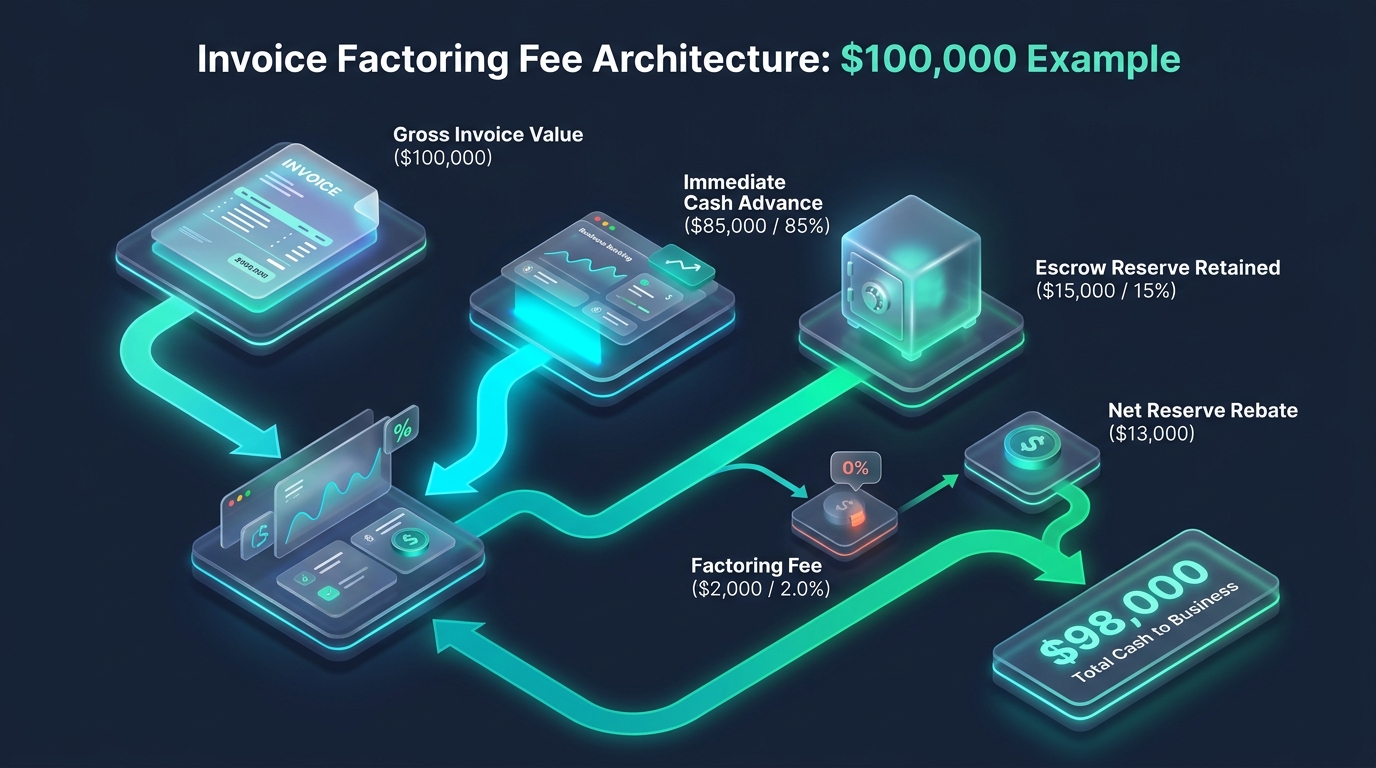
- The Immediate Advance (80% to 90%): The factoring provider wires an immediate capital advance into your operating bank account within 24 hours of invoice verification.
- The Reserve Escrow (10% to 20%): The lender retains the remaining percentage in a segregated reserve account to absorb payment delays, client chargebacks, or billing disputes.
- The Reserve Settlement (Rebate): Once your customer pays the invoice in full, the factor deducts their agreed factoring discount fee and remits the remaining reserve balance directly to you.
Real-World Mathematical Example: A \$100,000 Invoice Factored
To evaluate the real-world dollar cost of factoring, consider a manufacturing or B2B staffing firm factoring a \$100,000 corporate invoice under standard commercial terms. For companies evaluating structured workforce staffing overhead, reviewing our employer of record vs PEO difference guide provides critical insight into managing fixed payroll liabilities. Furthermore, multistate operations should model sales tax impacts using our economic nexus thresholds compliance guide to ensure gross billing values reflect verified tax reserves.
| Transaction Step | Mathematical Formula | Dollar Value (30-Day Pay) | Dollar Value (60-Day Pay) |
|---|---|---|---|
| Gross Invoice Face Value | Billed to corporate client | \$100,000.00 | \$100,000.00 |
| Immediate Cash Advance (85%) | \$100,000 × 85% | \$85,000.00 | \$85,000.00 |
| Reserve Held in Escrow (15%) | \$100,000 × 15% | \$15,000.00 | \$15,000.00 |
| Factoring Fee (2.0% per 30 Days) | \$100,000 × (2.0% per 30 days) | \$2,000.00 | \$4,000.00 (2 cycles) |
| Reserve Rebate Released to You | \$15,000 Reserve − Factoring Fee | \$13,000.00 | \$11,000.00 |
| Total Net Cash Received | Advance (\$85,000) + Rebate | \$98,000.00 | \$96,000.00 |
| Effective Annualized APR | (Fee ÷ Advance) × (365 ÷ Days) | 28.63% APR | 28.63% APR |
Flat Fee vs. Tiered Variable Fee Structures
Commercial factoring contracts generally utilize either flat fee pricing or variable tiered pricing models. Choosing the wrong structure can increase your total capital costs by over 50% if enterprise debtors routinely delay payments past maturity:
| Pricing Model | How Fee Is Calculated | Pros for Borrowers | Cons / Hidden Risks |
|---|---|---|---|
| Flat Factoring Fee | Fixed single rate (e.g., 2.5% flat) regardless of collection date within 60 or 90 days | Predictable budgeting; no penalties if clients pay slowly within window | Higher upfront cost if clients consistently settle within 15 to 20 days |
| Tiered Variable Fee (Bucket Rate) | Base rate for first 30 days (e.g., 1.5%), plus 0.5% for every additional 10 days past due | Extremely low costs for fast-paying Net 15 or Net 30 corporate clients | Costs escalate rapidly if customers delay settlement into 60+ days |
Uncovering Hidden Factoring Fees (Due Diligence Checklist)
The headline factoring discount rate rarely reflects the entire cost of an invoice factoring facility. Sophisticated factors offset low nominal rates with administrative surcharges. Audit commercial factoring proposals for the following secondary fee assessments:
- Origination & Setup Fees: One-time facility onboarding charges ranging from \$500 to \$2,500 for legal review and UCC-1 filing.
- Invoice Processing & Lockbox Fees: Administrative handling charges of \$10 to \$35 per uploaded invoice schedule.
- Wire Transfer & Settlement Fees: Outbound same-day wire fees ranging from \$25 to \$50 per advance release.
- Credit Check & Debtor Monitoring Fees: Quarterly or monthly monitoring charges (\$5 to \$15 per debtor) to track your customers’ corporate credit ratings.
- Minimum Monthly Volume Penalties: Assessment fees levied if your total monthly factored receivables fall below contracted threshold commitments.
Recourse vs. Non-Recourse Factoring Fee Impact
Non-recourse factoring carries a premium fee surcharge of 0.5% to 1.5% above standard recourse rates. In a recourse contract, your company must repurchase the invoice or swap it with a fresh claim if the client fails to settle after 90 days. In non-recourse factoring, the factor absorbs the loss if the debtor files for formal Chapter 7 or Chapter 11 bankruptcy.
Non-recourse agreements do not protect against commercial disputes, damaged goods, or billing disagreements. If a debtor withholds payment due to service dissatisfaction rather than technical legal insolvency, non-recourse clauses automatically revert liability back to your business.
Negotiation Playbook: How to Lower Your Factoring Fees
Piyush Dwivedi’s 4 Levers to Slash Factoring Rates
- Leverage Creditworthy Enterprise Debtors: Factors price risk based on your customers’ balance sheets, not yours. Factoring Fortune 500 or investment-grade government receivables yields discount rates as low as 0.75% to 1.25%.
- Commit to Higher Aggregate Monthly Volume: Agreeing to factor \$250,000+ monthly reduces rate schedules by 30% compared to spot-factoring individual \$25,000 invoices.
- Eliminate Minimum Volume Penalties: Negotiate away minimum monthly volume clauses to maintain flexibility without paying shortfall penalties during seasonal dips.
- Cap Ancillary Fees: Demand a flat monthly administrative fee that waives separate invoice processing, ACH transfer, and credit check fees.
What is a typical fee for invoice factoring?
Typical invoice factoring fees range from 1.0% to 4.5% of the gross invoice value per 30-day collection cycle, depending on debtor creditworthiness, monthly billing volume, and industry sector.
How is the factoring fee calculated?
The factoring fee is calculated by multiplying the gross invoice face value by the agreed discount rate, scaled by how many 30-day or 10-day cycles elapse before the customer settles the balance.
What is the difference between a discount rate and an advance rate?
The advance rate is the percentage of cash wired immediately to your business (typically 80% to 90%), while the discount rate is the actual fee percentage retained by the factoring company (typically 1% to 4%).
Why does invoice factoring have a high APR?
Factoring has a higher annualized APR (typically 20% to 40%) because it is short-term, uncollateralized commercial liquidity advanced against credit risk rather than a multi-year amortized bank loan.
Are invoice factoring fees tax-deductible?
Yes, invoice factoring fees and discount charges are fully tax-deductible as legitimate ordinary and necessary business financing expenses under IRS regulations.
-
What is a typical fee for invoice factoring?
Typical factoring fees range between 1.0% and 4.5% per 30-day collection period. High-volume businesses working with creditworthy enterprise debtors regularly secure discount rates near 1.0% to 1.5%.
-
How is the factoring fee calculated?
Multiply the total invoice value by the agreed discount rate for each elapsed billing cycle. On a \$100,000 invoice with a 2% monthly rate, the fee equals \$2,000 if settled within 30 days and \$4,000 if settled in 60 days.
-
What is the difference between a discount rate and an advance rate?
The advance rate represents the immediate liquidity wired to you, while the discount rate is the fee cost. An 85% advance rate releases \$85,000 on a \$100,000 invoice, while a 2% discount rate retains \$2,000 as the lender fee.
-
Why does invoice factoring have a high APR?
Factoring provides rapid 24-hour working capital without requiring fixed real estate collateral. Annualizing a 2% monthly financing fee across a 30-day window naturally produces an annualized APR near 28%.
-
Are invoice factoring fees tax-deductible?
Yes, factoring discount rates and processing fees are 100% tax-deductible. The IRS classifies commercial factoring fees as ordinary financial and interest charges on corporate tax returns.