















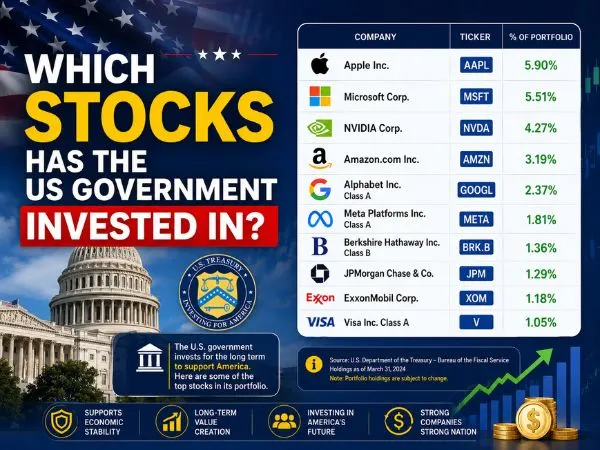
For decades, the idea of the US government actively buying stocks in individual public companies was unthinkable outside of a massive financial crisis (like the 2008 bank bailouts). But over the last couple of years, that paradigm has completely shifted.
Driven by the CHIPS Act, national security concerns, and a push for domestic supply chain resilience, the US government has quietly built a multi-billion-dollar direct equity portfolio. Rather than just giving out traditional grants, the government is increasingly taking ownership stakes in strategic sectors like semiconductors, critical minerals, and quantum computing.
If you are wondering which specific stocks the US government has invested in, here is the breakdown of the most notable holdings and what it means for everyday investors.
The “Government-Backed” Portfolio
The government’s current strategy revolves around securing dominance in industries that are critical to future technology and defense. This is not a broad, diversified index fund; it is a highly concentrated bet on specific sectors.
Here are some of the most significant public and private equity stakes the US government has taken recently:
| Company | Sector | Investment Amount | Government Stake |
| Intel (INTC) | Semiconductors | $8.9 Billion | ~9.9% Equity |
| USA Rare Earth | Critical Minerals | $1.6 Billion | ~16% Equity |
| SandboxAQ (Alphabet Spin-off) | AI & Quantum | $500 Million | Minority Equity |
| MP Materials (MP) | Rare Earths | $400 Million | ~15% Preferred Stock |
| Lithium Americas | Minerals | $182 Million | ~5% Equity |
| Vulcan Elements | Minerals | $50 Million | Minority Equity |
(Note: Data reflects publicly announced investments, CHIPS Act agreements, and defense commitments as of mid-2026).
also read : – PMFBY Scheme Guide: How to Protect Your Farm and Your Sleep
Explore the Investments by Sector
To get a better sense of where the capital is flowing, you can interact with this breakdown of the government’s strategic portfolio:
Key insight: Semiconductors and critical minerals completely dominate the portfolio. The government is directly funding the companies responsible for mining the raw materials and building the advanced chips required for AI and military hardware.
The Strategic Shift: Why Buy Stocks?
Why is the government buying equity instead of just handing out traditional subsidies or loans?
- Upside for Taxpayers: If these companies succeed, the unrealized gains benefit the Treasury rather than just private shareholders. For example, the government’s initial stake in Intel generated billions in unrealized paper gains shortly after the deal was executed.
- Guaranteed Demand: In many of these deals, the government isn’t just an investor; it is also the primary customer. For instance, the Pentagon committed to purchasing 100% of MP Materials’ rare earth magnets for a decade, creating a massive, guaranteed revenue floor for the company.
- Supply Chain Control: By taking equity—especially with specialized terms or “golden shares” (like the governance rights in U.S. Steel)—the government ensures that these critical companies cannot easily be sold to foreign adversaries or moved offshore.
Is This a “Buy” Signal for Retail Investors?
When the US government takes a 10% stake in a company, it is incredibly tempting to blindly copy the trade. However, there are significant risks to consider.
First, government backing provides a durable policy tailwind. It means permitting, contracts, and additional capital will likely flow easily to that sector. But government money cannot fix broken technology or poor management. A company can have federal funding and still completely fail to deliver on its product roadmap.
Second, the initial announcement often creates a massive day-one pop in the stock price. Retail investors who buy in late might be paying inflated prices for companies that are still years away from generating actual commercial revenue.
If you are looking at these stocks, use the government’s investment as a sector filter, not an automatic buy signal. It confirms that a specific industry has multi-year momentum, but you still need to conduct your own fundamental financial analysis on the individual companies before risking your capital.